

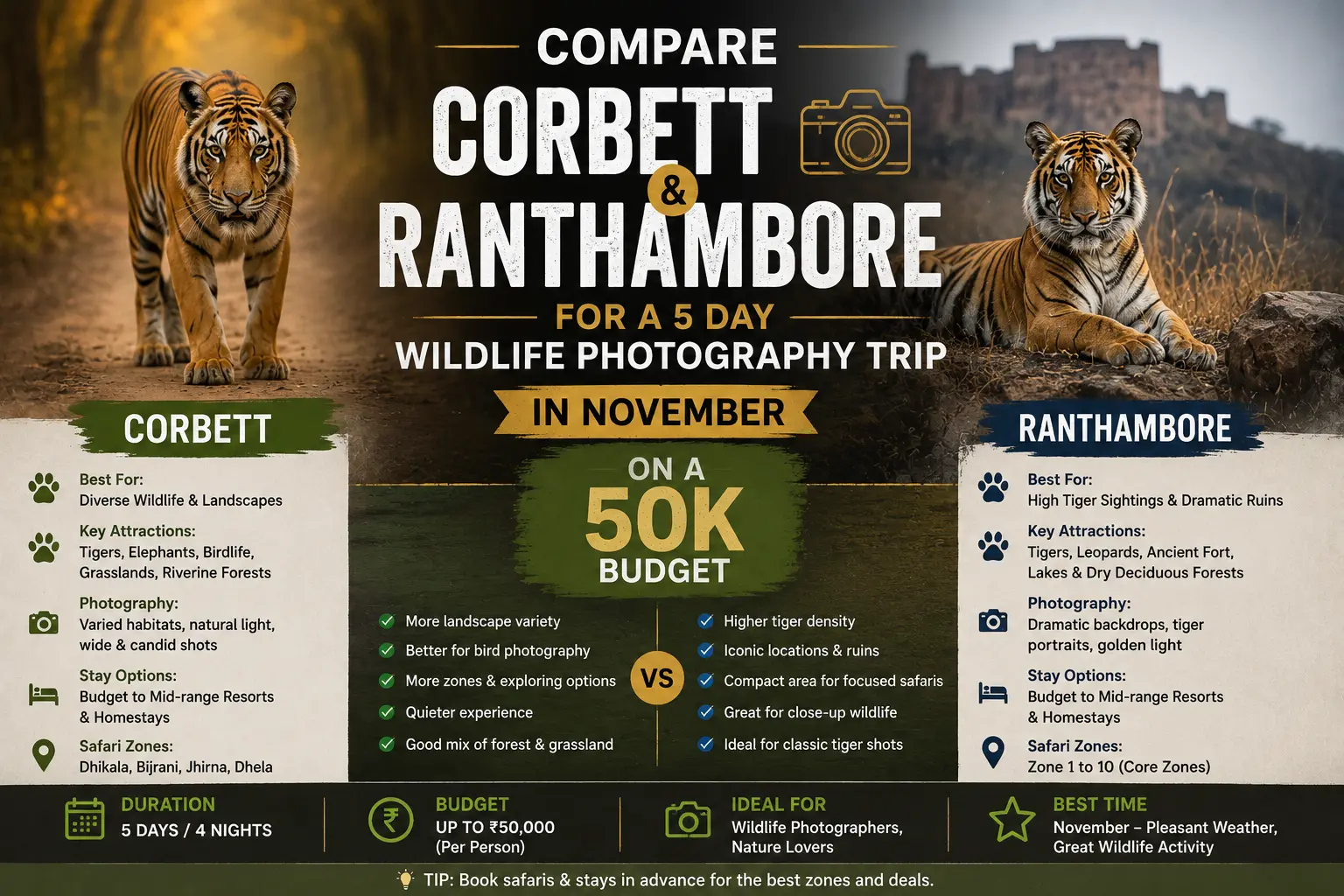
Wildlife photography enthusiasts planning a trip to India often face one important question: should they choose Jim Corbett National Park or Ranthambore National Park? Both destinations are among India’s most famous tiger reserves and offer unique opportunities for capturing breathtaking wildlife images. However, if you have only five days to spend in November and a budget of ₹50,000, making the right choice becomes even more important.
November is considered one of the best months for wildlife photography in India. The monsoon season has ended, forests are lush and green, temperatures are pleasant, and safari zones have reopened after seasonal closures. For photographers, this means excellent lighting conditions, active wildlife, and beautiful natural landscapes.
This guide compares Corbett and Ranthambore from a wildlife photography perspective, focusing on tiger sightings, landscapes, safari experiences, photography opportunities, and budget considerations.
Overview of Jim Corbett National Park
Located in Uttarakhand, Jim Corbett National Park is India’s oldest national park and one of the country’s most diverse wildlife destinations. The park features dense forests, river systems, grasslands, and hilly terrain, creating a rich ecosystem that supports tigers, elephants, leopards, crocodiles, deer, and hundreds of bird species.
For photographers, Corbett offers a true wilderness experience. The combination of rivers, misty forests, and dramatic landscapes allows photographers to create environmental wildlife portraits rather than simple animal close-ups. The famous Dhikala Zone is particularly known for its grasslands and river views, making it a favorite among serious wildlife photographers.
Overview of Ranthambore National Park
Situated in Rajasthan, Ranthambore National Park is one of India’s most famous tiger reserves. Unlike Corbett’s dense forests, Ranthambore features open woodland, lakes, rocky hills, and historic ruins. These open landscapes make wildlife easier to spot and photograph.
Ranthambore is especially famous for tiger photography. The park’s terrain often allows photographers to capture unobstructed images of tigers walking across roads, resting near lakes, or moving through ancient fort ruins. Zones 2, 3, and 4 are particularly popular due to their strong tiger presence and scenic photography opportunities.
Tiger Photography: Which Park is Better?
For photographers whose primary goal is capturing tiger images, Ranthambore generally has the advantage.
The open landscape improves visibility and allows photographers to frame subjects more easily. Tigers in Ranthambore are often spotted near lakes, roads, and open meadows, increasing the chances of obtaining sharp, well-composed photographs. Many wildlife photographers consider Ranthambore one of the best locations in India for tiger portraits.
Corbett, on the other hand, offers more challenging tiger photography. Dense vegetation can obscure subjects, and sightings often require patience. However, when photographers do encounter a tiger in Corbett, the surrounding environment frequently produces more dramatic and storytelling-oriented images. Tigers photographed near rivers, grasslands, or mist-covered forests create unique compositions that are difficult to replicate elsewhere.
Landscape Photography Opportunities
Landscape photography is where Corbett truly shines.
The park offers diverse scenery including forests, riverbanks, grasslands, and mountain backdrops. Morning fog during November can create atmospheric images that are highly sought after by professional photographers. The Ramganga River and Dhikala grasslands provide countless opportunities for environmental wildlife photography.
Ranthambore’s landscapes are equally beautiful but differ significantly. The combination of lakes, rocky terrain, and centuries-old ruins creates a dramatic backdrop for wildlife images. Photographers who enjoy combining history and wildlife often prefer Ranthambore because its fort structures and ancient architecture add unique elements to compositions.
Bird Photography and Biodiversity
If your photography interests extend beyond tigers, Corbett offers a clear advantage.
The park supports a wider range of wildlife species, including elephants, gharials, otters, leopards, and more than 600 bird species. Kingfishers, hornbills, eagles, and numerous migratory birds can be photographed during November. This diversity ensures photographers remain productive even when tiger sightings are limited.
Ranthambore also hosts numerous bird species and mammals, but its primary attraction remains tiger photography. While visitors may photograph crocodiles, sloth bears, deer, and birds, the overall biodiversity experience is generally less extensive compared to Corbett.
November Weather and Light Conditions
November provides excellent photography conditions in both parks.
Corbett experiences cooler mornings with occasional mist and fog. These conditions create soft, diffused lighting that is ideal for atmospheric wildlife photography. However, fog may occasionally reduce visibility during early safaris.
Ranthambore generally enjoys clear skies and stronger sunlight. Photographers benefit from consistent golden-hour lighting and greater visibility throughout safari drives. The predictable weather makes it easier to plan photography sessions.
Budget Breakdown on Compare Corbett and Ranthambore for a 5 Day Wildlife Photography Trip in November on a 50K Budget
A ₹50,000 budget can comfortably accommodate either destination with careful planning.
Estimated Corbett Budget
- Travel: ₹8,000–₹12,000
- Accommodation (4–5 nights): ₹15,000–₹20,000
- Safari expenses: ₹8,000–₹12,000
- Food and miscellaneous expenses: ₹5,000–₹7,000
Estimated Total: ₹36,000–₹50,000.
Estimated Ranthambore Budget
- Travel: ₹10,000–₹15,000
- Accommodation (4–5 nights): ₹18,000–₹22,000
- Safari expenses: ₹10,000–₹15,000
- Food and miscellaneous expenses: ₹5,000–₹7,000
Estimated Total: ₹43,000–₹50,000. Ranthambore tends to be slightly more expensive due to higher demand and increased safari fees.
Safari Strategy for Photographers
Regardless of the destination, multiple safaris are essential for maximizing photographic opportunities. Wildlife photographers and experienced travelers frequently recommend booking at least three to five safaris during a five-day trip. Multiple drives significantly improve the chances of observing interesting animal behavior and obtaining high-quality images. ()
In Corbett, photographers should prioritize Dhikala, Bijrani, and Jhirna zones whenever possible. In Ranthambore, Zones 2, 3, 4, and 5 are generally preferred for tiger photography.
Read More: Labarty: Why Freedom, Choice, and Personal Rights Continue to Shape Modern Society
Final Verdict on Compare Corbett and Ranthambore for a 5 Day Wildlife Photography Trip in November on a 50K Budget
The answer depends entirely on your photography goals.
Choose Ranthambore National Park if:
- Tiger photography is your top priority.
- You want higher chances of wildlife sightings.
- You prefer open landscapes and easier compositions.
- You are a beginner wildlife photographer.
Choose Jim Corbett National Park if:
- You want greater biodiversity.
- You enjoy landscape and bird photography.
- You prefer environmental storytelling images.
- You seek a more immersive wilderness experience.
For a dedicated tiger photographer visiting India in November on a ₹50,000 budget, Ranthambore usually delivers the best return on investment. However, for photographers interested in creating a diverse portfolio featuring landscapes, birds, elephants, and forest ecosystems alongside tiger encounters, Corbett remains an outstanding choice.
Ultimately, both parks offer unforgettable wildlife photography experiences. The best destination is the one that aligns most closely with your creative vision and photographic goals.
