

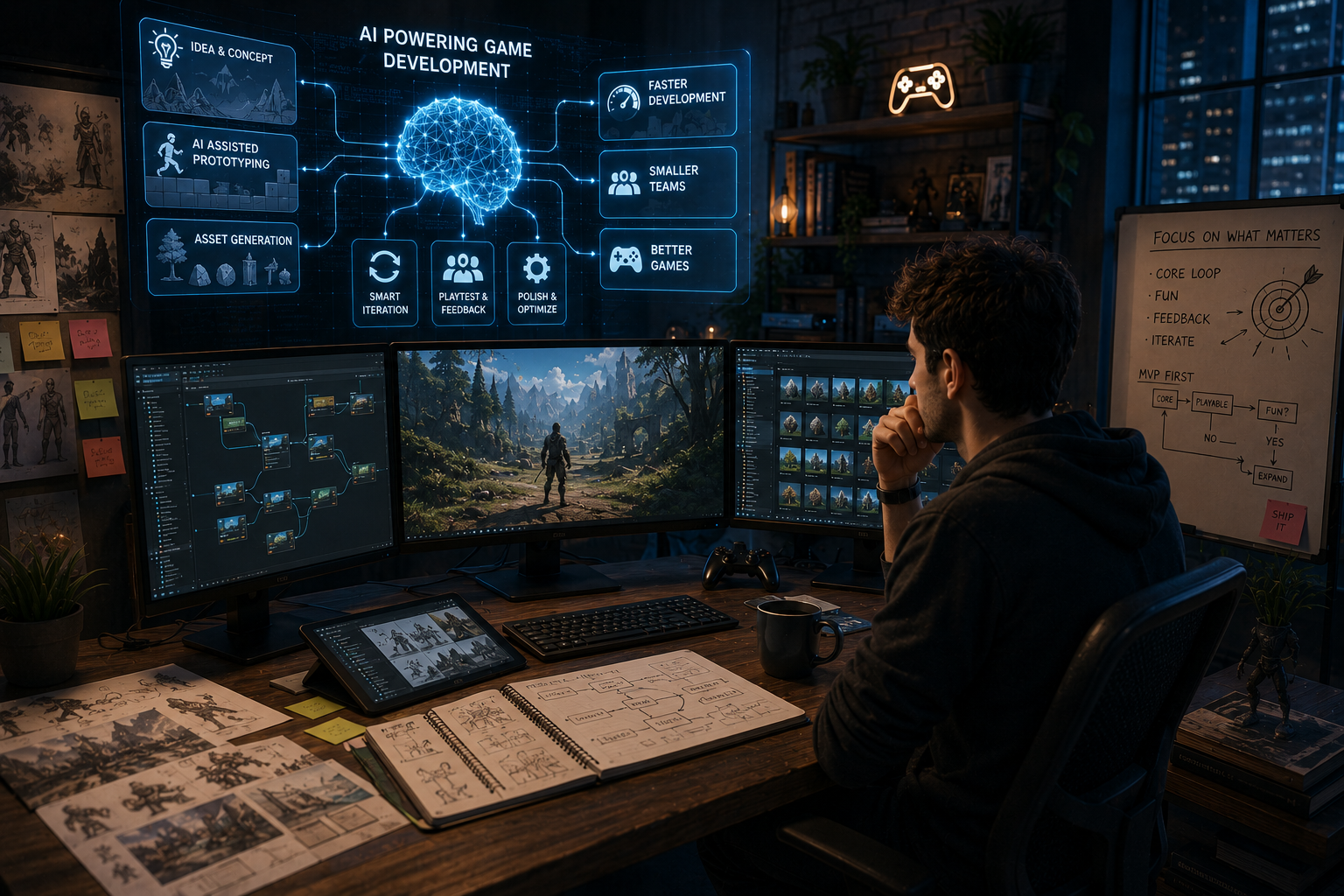
A decade ago, calling AI “essential” to game development would have sounded like marketing hype. Today it’s closer to a practical description of how a growing share of studios, from solo creators to mid-sized teams, actually work. The shift didn’t happen because AI became more impressive as a concept. It happened because it started solving real, persistent problems that development has struggled with for decades.
Here’s why AI has moved from optional experiment to something closer to standard practice, and what that actually means for how games get made.
The Problem AI Is Actually Solving
Game development has always had an uneven relationship between ambition and available time. Ideas are cheap. Execution is expensive. That imbalance has shaped the industry for decades, forcing teams to cut scope, extend timelines, or hire more people just to keep pace with what they wanted to build. AI doesn’t eliminate that imbalance, but it shifts it meaningfully, letting smaller teams and individual creators execute closer to the scale their ambition actually calls for.
Why “Essential” Isn’t an Exaggeration Anymore
Competitive Pressure Has Shifted
Teams using AI-assisted workflows can prototype, iterate, and test more ideas in the same amount of time as teams relying entirely on manual implementation. That speed difference compounds over a project’s lifetime. Studios that ignore these tools aren’t just working differently, they’re working at a structural time disadvantage compared to those that aren’t.
Player Expectations Keep Rising
Players compare every new release against an ever-growing baseline of polish and content, regardless of a team’s size or budget. Meeting that baseline without AI-assisted tools increasingly requires either a much larger team or a much longer timeline, neither of which is realistic for most creators.
The Cost of Testing Ideas Has Dropped System-Wide
When testing an idea is expensive, teams commit early and iterate less. AI has lowered that cost significantly, which means the studios and creators getting the best results are the ones testing far more variations before committing, not necessarily the ones with the most resources.
Where AI Has Become Genuinely Load-Bearing
Prototyping and Concept Validation
Instead of spending weeks determining whether an idea has potential, teams can now get a playable version in hours. Make your own game platforms have made this stage fast enough that skipping it, and building based purely on assumption, has become the riskier choice rather than the efficient one.
Asset Production at Small-Team Scale
Small teams historically couldn’t compete with larger studios on content volume or visual production. AI-assisted asset generation narrows that gap enough that content volume is no longer an automatic advantage for bigger teams, at least not to the degree it once was.
Iteration Speed on Core Mechanics
Games like Obliterate Earth reflect what repeated, fast iteration can produce, a core mechanic that feels tuned through many small adjustments rather than a single long, guessed-at build cycle. That level of refinement used to require far more time and often a larger team than a game like this would suggest.
Why This Isn’t Replacing Developers, It’s Reshaping the Role
Implementation Time Shrinks, Judgment Time Grows
The essential value AI provides isn’t creative output, it’s time. Time that used to go toward manual implementation increasingly goes toward playtesting, balancing, and refining, the parts of development that actually determine whether a game is good. Developers aren’t doing less. They’re doing more of what actually mattered all along.
Technical Skill Alone Is Less of a Differentiator
When implementation speed becomes accessible to nearly everyone, the developers and teams that stand out increasingly differentiate themselves through design judgment, taste, and iteration discipline rather than raw technical execution ability alone.
Small Teams Compete Differently Than They Used To
A two-person team using AI-assisted tools can now realistically compete on polish and iteration count with teams several times their size. That doesn’t erase every advantage a bigger studio has, but it changes what those advantages actually are.
Where AI Still Isn’t Essential, and Might Never Be
Deeply Technical, Novel Systems
Highly specific technical requirements, custom netcode, unusual rendering techniques, deeply original systems that don’t resemble existing patterns, still often require direct, manual engineering. AI accelerates common patterns far more reliably than it handles genuinely novel technical problems.
Creative Vision and Direction
No tool generates the underlying reason a game is worth making. That vision, and the taste required to recognize when something is actually working, remains entirely a human responsibility, and there’s no indication that’s changing anytime soon.
Community and Player Relationship Management
Understanding a player base, responding to community feedback, and making judgment calls about what a specific audience actually wants still depends on human attention and relationship-building that automation doesn’t meaningfully touch.
What This Means for Developers Right Now
Learning These Tools Is Becoming a Practical Necessity
Much like learning a game engine became standard practice years ago, working effectively with AI-assisted development tools is becoming a comparable baseline skill, not because it replaces other knowledge, but because it compounds with it.
The Advantage Goes to Teams That Iterate More, Not Just Faster
Speed alone isn’t the differentiator. Teams that use that speed to genuinely test more ideas and refine based on real feedback pull ahead of teams that just produce more content faster without using that time to actually improve decision quality.
Adaptability Matters More Than Mastering Any Single Tool
The specific platforms will keep changing. What matters longer-term is developing the habit of using fast iteration well, testing deliberately, watching real player behavior, and reinvesting saved time into judgment rather than just output volume.
Final Thoughts
AI has become essential in modern game development not because it replaces the creative and technical skill that’s always driven good games, but because it removes enough friction from execution that teams of every size can spend more of their time on the decisions that actually matter. The studios and creators treating it as essential aren’t cutting corners. They’re redirecting the time they save toward more testing, more refinement, and ultimately better games.
The tools will keep evolving, but the underlying shift is unlikely to reverse. Development has permanently moved toward faster execution and more deliberate iteration, and the developers who adapt to that reality tend to build better games in less time than the ones still working entirely by hand.
