

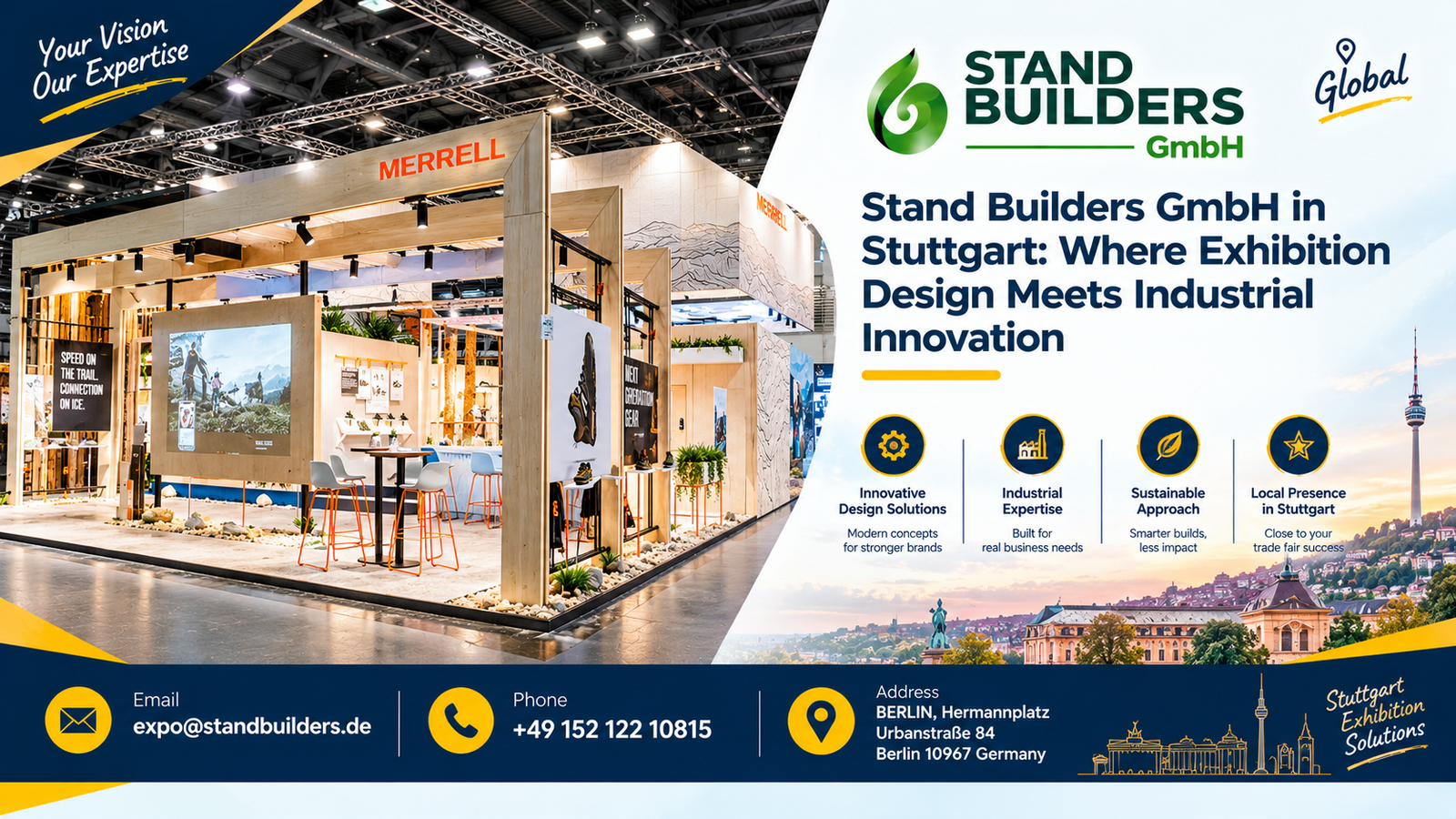
Stuttgart has developed a strong reputation as a centre for engineering, manufacturing, automotive technology, and industrial innovation. Its trade fairs provide businesses with opportunities to introduce technical products, meet international buyers, and explore new commercial partnerships. However, presenting a company effectively at these events requires more than an attractive booth. Businesses looking for the best Stand builder in Germany should consider how exhibition design, construction quality, and project coordination contribute to a successful trade fair appearance. Stand Builders GmbH supports exhibitors in Stuttgart by developing exhibition spaces that reflect their business objectives and practical presentation requirements.
Stuttgart’s Exhibition Environment Demands More Than Visual Appeal
Unlike exhibitions focused primarily on lifestyle or consumer products, many industrial trade fairs require detailed technical presentations. Visitors may include engineers, procurement managers, distributors, manufacturers, and business decision-makers who expect useful information rather than decorative displays.
This creates a particular challenge for exhibitors. Their stands must be visually recognisable while providing enough space to explain products, demonstrate equipment, and conduct professional discussions. A poorly organised layout can make even an innovative product difficult to understand.
Stuttgart’s exhibition environment is especially relevant to companies operating in automation, machine tools, industrial components, and advanced manufacturing. Events associated with these sectors encourage businesses to think carefully about how technical information should be presented.
An effective exhibition stand therefore needs to balance three priorities: clear brand communication, functional product presentation, and comfortable visitor interaction.
How Stand Builders GmbH Approaches Exhibition Projects in Stuttgart
Stand Builders GmbH is a Berlin-based exhibition stand design and construction company providing services across Germany and Europe. Its dedicated exhibition stand design company in Stuttgart page describes solutions covering stand design, manufacturing, logistics, installation, and project management.
The company focuses on developing exhibition environments around the exhibitor’s products, brand identity, and event objectives. Rather than treating every stand as a standard structure, the design process considers the available space, presentation requirements, and the type of audience attending the event.
The Stuttgart service page also highlights in-house production facilities, English-speaking project managers, delivery arrangements, and technical support. These capabilities are particularly relevant to international businesses that may be unfamiliar with German exhibition procedures.
Having a defined project contact can make communication easier when several activities must be coordinated within a limited schedule.
Designing Exhibition Spaces for Technical Products
Industrial products often require a different presentation strategy from ordinary promotional displays. Machinery, components, software platforms, and manufacturing systems may need demonstrations or detailed explanations before visitors can appreciate their value.
A stand intended for technical presentations should make information easy to access. Products need appropriate display positions, presentation screens should remain visible, and visitors should be able to move comfortably between demonstration and discussion areas.
For example, an automation company may want to demonstrate a working system while providing a separate meeting area for technical conversations. A component manufacturer may need organised display counters where visitors can compare different products.
In both situations, the layout should help visitors understand the offering without creating unnecessary obstacles.
Stand Builders GmbH develops stand concepts that can incorporate customised displays, branded graphics, lighting, and interactive presentation features according to project requirements.
Four Exhibition Stand Services Offered by Stand Builders GmbH
Different businesses require different structures depending on their exhibition objectives, available space, and frequency of participation. Stand Builders GmbH offers four principal exhibition stand solutions, each serving a distinct purpose.
1. Custom Exhibition Stands for Individual Brand Presentations
Custom exhibition stands are developed around a company’s specific identity and presentation needs. Their layouts, materials, display elements, and architectural features can be planned to create a distinctive exhibition environment.
This approach is useful for businesses introducing new technologies, displaying specialised products, or preparing for major industry events.
A custom stand can include demonstration zones, reception counters, branded walls, product displays, and private meeting areas. The design should reflect the company’s message while remaining practical for staff and visitors.
2. Modular Exhibition Stands for Flexible Participation
Modular stands use adaptable components that can be configured for different exhibition spaces.
They are particularly relevant to companies participating in several trade fairs throughout the year. Rather than developing a completely new structure for each event, suitable components can be reused and rearranged.
Graphics and display features may also be updated to reflect changing products or campaigns.
Modular construction can support more efficient long-term exhibition planning, although transport, maintenance, and storage requirements must still be considered.
3. Double-Decker Exhibition Stands for Additional Space
Double-decker stands provide an upper level within the exhibition structure, creating additional usable space without requiring the same increase in ground-floor area.
These stands can be useful for larger exhibitors that need separate areas for public demonstrations and private meetings.
The ground floor may accommodate product presentations and visitor reception, while the upper level can be reserved for discussions or hospitality.
Because double-decker stands involve additional structural requirements, their construction must comply with the relevant exhibition venue regulations and approval procedures.
4. Country Pavilion Stands for Group Exhibitions
Country pavilion stands are designed to bring several exhibitors together under a coordinated exhibition identity.
They are commonly suitable for trade associations, export promotion organisations, and national business delegations participating in international events.
A pavilion needs to maintain a consistent overall appearance while providing individual spaces for participating companies.
Stand Builders GmbH develops country pavilion solutions that combine shared visual elements with separate branding and presentation areas, helping multiple exhibitors participate within an organised environment.
The Importance of Production Quality and Construction Planning
An exhibition stand must do more than look convincing in a design presentation. Its components must be manufactured accurately and assembled within the venue’s permitted installation period.
Stand Builders GmbH highlights its in-house production capabilities as part of its exhibition construction services. This supports coordination between approved designs and the physical components required for installation.
Manufacturing requirements may include structural walls, display counters, branded features, furniture arrangements, and other customised elements.
The materials selected should be appropriate for the intended structure, expected usage, and technical requirements.
Production planning also needs to account for the event schedule. Late changes to stand dimensions, display equipment, or major design features can affect manufacturing and delivery arrangements.
For this reason, exhibitors benefit from reviewing designs carefully before approving production.
Why Logistics Can Influence the Exhibition Experience
Transport and installation are often overlooked during the early stages of exhibition planning. However, they can significantly affect whether a stand is ready before the event begins.
Exhibition venues operate under specific delivery and build-up schedules. Materials must arrive at the correct location, installation teams must follow site procedures, and construction must be completed within the allocated period.
The Stuttgart page of Stand Builders GmbH describes delivery support, stand installation, dismantling, and technical assistance as part of its project services.
These activities require coordination between manufacturing teams, transport providers, venue personnel, and installation crews.
For exhibitors travelling from abroad, having these responsibilities managed through a defined project process can reduce the number of separate arrangements they need to oversee.
What Should Exhibitors Prepare Before Requesting a Quotation?
A useful exhibition stand proposal begins with accurate information about the project.
Businesses should provide the exhibition name, venue, stand dimensions, event dates, branding requirements, and estimated budget. Information about product displays, machinery, meeting areas, and digital equipment is equally important.
For industrial exhibitors, technical details deserve particular attention. Large products may require specific floor-loading considerations, access arrangements, electrical connections, or additional installation planning.
Companies should also share the organiser’s technical guidelines whenever available.
A clear project brief helps the stand designer understand what the exhibition space must accomplish and makes it easier to develop an appropriate proposal.
Building a Stand That Supports Real Business Conversations
The value of an exhibition stand is not measured only by the number of visitors who notice it. What matters is whether the environment helps the exhibitor communicate effectively with relevant people.
A well-positioned demonstration area can encourage technical discussions. Comfortable meeting spaces can support negotiations, while clear graphics can help visitors quickly identify suitable products or services.
Exhibition staff also need a practical working environment. Storage areas, accessible presentation equipment, and sufficient circulation space can make daily operations easier.
These considerations may appear minor during the initial design stage, but they influence how the stand performs throughout the exhibition.
Businesses should therefore evaluate their stand designs from both the visitor’s and the exhibitor’s perspective.
The Exhibition Does Not End When the Doors Close
After the event, the stand must be dismantled according to the organiser’s schedule. Reusable components should be packed carefully and assessed for future use.
Stand Builders GmbH includes dismantling among its exhibition-related services, supporting the final stage of the project.
This is also an appropriate time for businesses to review their exhibition performance. Staff feedback can reveal whether the layout supported demonstrations, whether meeting areas were sufficient, and which display features attracted meaningful attention.
These observations can guide future design improvements and help exhibitors make better decisions about reusable structures, equipment, and exhibition budgets.
Conclusion
Stuttgart’s industrial and technology-focused exhibition environment creates valuable opportunities for businesses that want to present innovations and develop professional relationships. However, successful participation depends on careful planning, functional design, reliable construction, and coordinated event preparation. Stand Builders GmbH provides exhibition stand design and construction services in Stuttgart, including custom stands, modular structures, double-decker stands, and country pavilion solutions. Its broader services cover design development, manufacturing, logistics, installation, technical support, and dismantling.
For companies preparing to exhibit in Stuttgart, the most effective approach is to begin with clear business objectives, understand the requirements of the venue, and select a stand structure that supports both product presentation and visitor interaction. When these elements are considered together, an exhibition stand becomes a purposeful business environment rather than simply a temporary display.
