

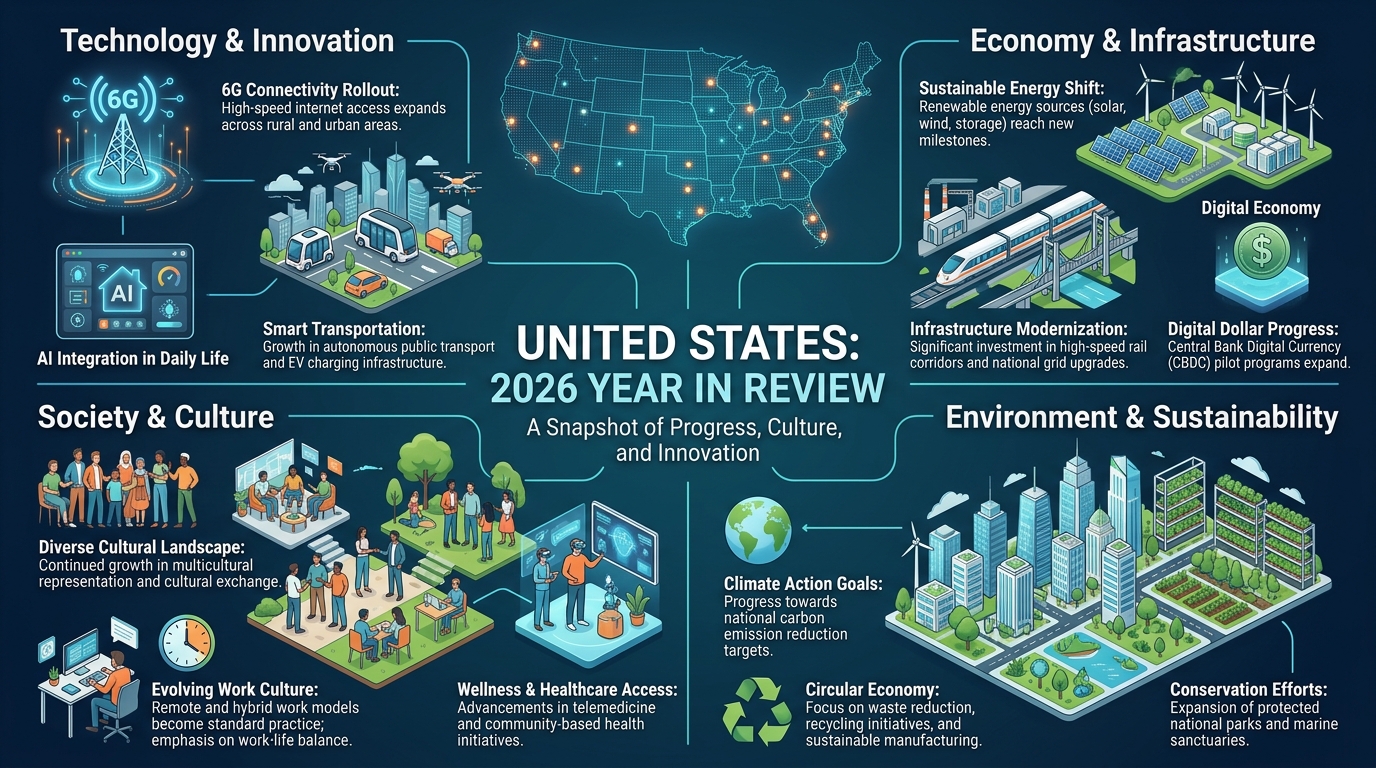
The United States remains among the world’s most influential nations in 2026. Known for its economic strength, technological innovation, cultural diversity, and global leadership, it plays a central role in international affairs. From its founding in 1776 to its current position as the world’s largest economy by nominal GDP, the country continues to shape politics, science, business, education, and entertainment.
Whether you are a student, traveler, investor, or simply curious, this comprehensive guide explains the country’s history, geography, government, economy, people, and culture using accurate information from trusted sources such as the U.S. Census Bureau, World Bank, International Monetary Fund (IMF), United Nations, and the U.S. Bureau of Economic Analysis.
Quick Facts
| Category | Information |
| Official Name | United States of America |
| Capital | Washington, D.C. |
| Largest City | New York City |
| Continent | North America |
| States | 50 |
| Federal District | Washington, D.C. |
| Population | About 340 million (the latest U.S. Census Bureau estimate) |
| Currency | United States Dollar (USD) |
| Official Language | No federal official language (English is most widely spoken) |
| Government | Federal Constitutional Republic |
| Independence | July 4, 1776 |
| Time Zones | Six primary time zones across states and territories |
History
The story of the United States began long before European settlement. Indigenous peoples lived across North America for thousands of years, developing diverse cultures and advanced societies.
Colonial Period
Beginning in the early 1600s, Britain established colonies along the Atlantic coast. By the eighteenth century, the thirteen colonies had become economically successful but increasingly opposed British taxation and political control.
Independence
On July 4, 1776, the Continental Congress adopted the Declaration of Independence. After the Revolutionary War, the nation gained formal independence through the Treaty of Paris in 1783.
Growth and Expansion
Throughout the nineteenth century, the country expanded westward through purchases, treaties, and settlement. Major milestones included:
- Louisiana Purchase (1803)
- Texas Annexation (1845)
- California Gold Rush (1848)
- Completion of the Transcontinental Railroad (1869)
Civil War
The Civil War (1861–1865) was fought primarily over slavery and states’ rights. Union victory preserved the nation and led to the abolition of slavery through the Thirteenth Amendment.
Modern Era
During the twentieth century, America emerged as a global power following victories in World War I and World War II. It later became a leader in technology, medicine, finance, and space exploration.
Geography
Located in North America, the country covers approximately 9.83 million square kilometers, making it the world’s third- or fourth-largest nation by total area.
Major geographic regions include:
- Northeast
- Midwest
- South
- West
- Alaska
- Hawaii
Natural features include:
- Rocky Mountains
- Appalachian Mountains
- Great Plains
- Mississippi River
- Colorado River
- Great Lakes
- Grand Canyon
The nation experiences nearly every major climate type, from Arctic conditions in Alaska to tropical weather in Hawaii and Florida.
Government and Political System
The federal government operates under the U.S. Constitution, adopted in 1787.
Three Branches
Executive Branch
- President
- Vice President
- Cabinet agencies
Legislative Branch
- Senate
- House of Representatives
Judicial Branch
- Supreme Court
- Federal courts
This separation of powers helps balance authority and protect constitutional rights.
Economy
The United States has the world’s largest economy by nominal GDP.
Key Statistics
| Economic Indicator | Approximate Value |
| Nominal GDP | Over $30 trillion (IMF, latest estimate) |
| Major Currency | USD |
| Largest Stock Exchanges | NYSE, Nasdaq |
| Major Industries | Technology, Healthcare, Manufacturing, Finance, Agriculture |
Leading companies include:
- Apple
- Microsoft
- Amazon
- Alphabet (Google)
- NVIDIA
- JPMorgan Chase
Innovation remains a major driver of economic growth through artificial intelligence, biotechnology, aerospace, and renewable energy.
Population and Demographics
According to recent U.S. Census Bureau estimates, the population exceeds 340 million people.
The nation is one of the world’s most culturally diverse societies due to centuries of immigration.
Major metropolitan areas include:
- New York City
- Los Angeles
- Chicago
- Houston
- Phoenix
- Dallas
- Miami
- Atlanta
Life expectancy is approximately 77–79 years, depending on the reporting year and source.
States and Major Cities
The country consists of 50 states and one federal district.
Largest States by Area
| State | Approximate Area |
| Alaska | 1.72 million km² |
| Texas | 695,662 km² |
| California | 423,967 km² |
Largest Cities
- New York City
- Los Angeles
- Chicago
- Houston
- Phoenix
Each state maintains its own constitution, governor, legislature, and court system.
Education
The country hosts many internationally recognized universities.
Examples include:
- Harvard University
- Stanford University
- Massachusetts Institute of Technology (MIT)
- Princeton University
- Yale University
Higher education attracts more than one million international students in many academic years, according to Open Doors reports.
Science and Innovation
The nation has contributed significantly to scientific discovery.
Achievements include:
- Apollo Moon missions
- GPS technology
- Internet development
- Artificial intelligence research
- Medical innovations
- Biotechnology
- Space exploration through NASA
American researchers have received hundreds of Nobel Prizes across multiple disciplines.
Culture
American culture reflects influences from Indigenous peoples, Europe, Africa, Asia, Latin America, and the Middle East.
Popular cultural exports include:
- Hollywood films
- Jazz
- Rock
- Hip-hop
- Country music
- Television
- Professional sports
Major sports include:
- American football
- Baseball
- Basketball
- Ice hockey
- Soccer
Tourism
Millions of international visitors travel to the country each year.
Popular destinations include:
- Grand Canyon
- Yellowstone National Park
- Statue of Liberty
- Times Square
- Walt Disney World
- Las Vegas
- Golden Gate Bridge
- Niagara Falls
- Yosemite National Park
The National Park System manages more than 400 protected sites, preserving natural and historical landmarks.
International Influence
The nation maintains one of the world’s largest diplomatic networks and plays a leading role in organizations such as:
- United Nations
- NATO
- World Bank
- International Monetary Fund
- G7
- G20
Its military, economy, universities, entertainment industry, and technology companies contribute to a substantial global influence.
Key Facts at a Glance
| Feature | Details |
| Capital | Washington, D.C. |
| Largest City | New York City |
| Currency | USD |
| States | 50 |
| Population | 340+ million |
| GDP | $30+ trillion |
| Independence | July 4, 1776 |
| Government | Federal Constitutional Republic |
Frequently Asked Questions
Washington, D.C., serves as the nation’s capital and is home to the White House, Congress, and the Supreme Court.
How many states are there?
There are 50 states.
What is the largest state?
Alaska is the largest by land area.
What is the largest city?
New York City has the largest population.
What currency is used?
The official currency is the United States Dollar (USD).
What is the population in 2026?
Current estimates place the population at more than 340 million people.
Yes. By nominal GDP, it remains the world’s largest economy according to the International Monetary Fund.
Is UK English the official language?
There is no official language at the federal level, although English is the primary language used throughout the country.
What are the most visited tourist attractions?
Popular attractions include the Grand Canyon, Yellowstone, Times Square, the Statue of Liberty, Walt Disney World, and the Golden Gate Bridge.
Why is the country important globally?
It is a leader in innovation, finance, higher education, science, defense, culture, and international diplomacy.
Sources
- U.S. Census Bureau
- World Bank
- International Monetary Fund (IMF)
- United Nations
- U.S. Bureau of Economic Analysis
- National Park Service
- NASA
- Open Doors Report (Institute of International Education)
Conclusion
The United States continues to shape global developments through its economic strength, democratic institutions, scientific achievements, and cultural influence. With fifty states, remarkable geographic diversity, world-renowned universities, leading technology companies, and a history that has influenced international affairs for centuries, it remains one of the most studied and visited countries in the world. Whether your interest lies in history, travel, business, or education, understanding this nation provides valuable insight into many of the forces that shape today’s global landscape in 2026.
